“When God Destroys to Restore: The Purifying Judgment of Micah 5:10–15”

1. Divine Removal of False Security (vv. 10–11)
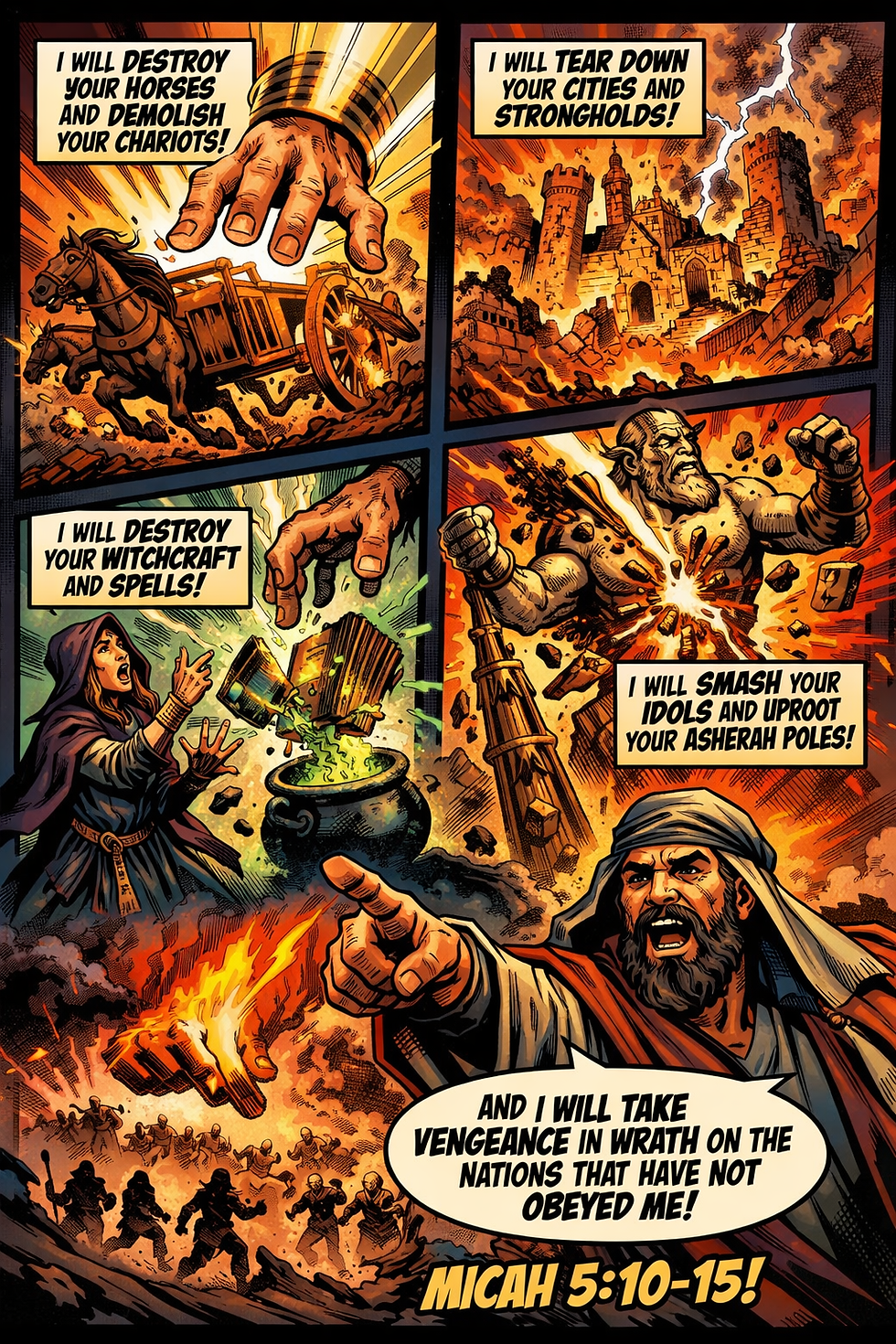
“I will destroy your horses… demolish your chariots… destroy the cities… tear down all your strongholds.”
In the ancient Near Eastern context, horses and chariots symbolized military strength and national security (cf. Psalm 20:7). Israel was tempted to trust in visible power structures rather than in Yahweh. The destruction of cities and strongholds indicates the dismantling of human-reliant infrastructure.
This reflects a consistent biblical theme: God opposes self-reliance when it replaces trust in Him. The Hebrew verbs here (often in the Hiphil stem) emphasize God as the active agent—He is intentionally dismantling what His people depend on apart from Him.
Cross Reference:
Isaiah 31:1 – “Woe to those who go down to Egypt for help… who trust in chariots…”
Zechariah 4:6 – “Not by might nor by power, but by my Spirit…”
Theological Insight:God’s deliverance often involves subtraction before addition. He removes what competes with His lordship.
2. Elimination of Occult Practices (v. 12)
“I will destroy your witchcraft and you will no longer cast spells.”
The term for “witchcraft” (Hebrew: kesaphim) refers to sorcery and attempts to manipulate spiritual realities apart from God. Such practices were strictly forbidden in the Mosaic Law (Deuteronomy 18:10–12). Their presence in Israel indicates deep spiritual compromise.
God’s judgment here is not merely punitive—it is purifying. The removal of witchcraft signifies a return to exclusive reliance on Yahweh.
Cross Reference:
Deuteronomy 18:10–12 – Prohibition of divination and sorcery
Acts 19:18–19 – Believers renounce occult practices
Theological Insight:Any attempt to control outcomes apart from God is idolatry in practice, even if it appears spiritual.
3. Destruction of Idolatry (vv. 13–14)
“I will destroy your idols… sacred stones… Asherah poles…”
Idolatry is the central issue. The “work of your hands” highlights human-created objects being worshiped as divine. Asherah poles were associated with Canaanite fertility worship, representing syncretism—blending pagan practices with Yahweh worship.
The language of “uprooting” suggests total eradication. God is not interested in partial reform; He demands exclusive worship.
Cross Reference:
Exodus 20:3–4 – “You shall have no other gods before me…”
1 John 5:21 – “Dear children, keep yourselves from idols.”
Theological Insight:Idolatry is not just the worship of false gods—it is the elevation of anything to a place that belongs to God alone.
4. Divine Vengeance on Disobedient Nations (v. 15)
“I will take vengeance in anger and wrath on the nations that have not obeyed me.”
This final verse broadens the scope beyond Israel. God’s justice extends to all nations. The phrase “have not obeyed” underscores accountability to divine authority, whether through general revelation or covenantal knowledge.
The vengeance described here is not arbitrary rage but righteous judgment. It affirms God’s holiness and His commitment to justice.
Cross Reference:
Psalm 96:13 – “He will judge the world in righteousness…”
Romans 12:19 – “Vengeance is mine, says the Lord.”
Theological Insight:God’s kingdom involves both purification of His people and judgment of persistent rebellion.
Reflection
Micah 5:10–15 reveals a God who is deeply committed to the holiness of His people. What stands out is that many of the things God destroys are not inherently evil (like cities or horses), but become problematic when they replace trust in Him.
This passage challenges modern readers to examine subtle forms of idolatry. While we may not bow to carved images, we often rely on:
Financial security instead of God’s provision
Influence or status instead of God’s approval
Control over outcomes instead of surrender to God’s will
God’s refining work can feel like loss. When He “destroys” certain supports in our lives, it may actually be His mercy—removing what hinders deeper dependence on Him.
Personal Application
Identify False Dependencies
Ask: What do I rely on for security besides God? Career, relationships, resources, or personal abilities? Like Israel’s horses and chariots, these can subtly replace trust in God.
Renounce Subtle Idolatry
Modern idolatry often takes the form of priorities rather than objects. Anything that consumes your ultimate devotion, time, or identity can function as an idol.
Submit to God’s Purifying Work
When God removes something from your life, resist the urge to rebuild it prematurely. Instead, discern whether He is calling you to deeper trust.
Pursue Exclusive Worship
Cultivate practices that center your life on God—prayer, Scripture, obedience. True worship is not just verbal; it is directional—where your life is aimed.
Prayer
Heavenly Father,You are holy, righteous, and worthy of all my trust. I confess that I often place my confidence in things I can see and control rather than in You. Forgive me for the ways I have relied on my own strength, resources, and understanding.
Lord, search my heart and reveal any idols that I have allowed to take Your place. Uproot anything in my life that competes with Your authority and Your glory. Even when it is painful, help me to trust that Your work is good and for my restoration.
Teach me to depend fully on You—not on what I can build, achieve, or secure. Align my heart with Your will, and purify my worship so that it is sincere and undivided.
Strengthen me to walk in obedience and faith, trusting that You are my true source of security, provision, and peace. May my life reflect Your holiness and bring You glory.
In Jesus’ name,Amen.


Comments