Christ Revealed in the Passover: The Messiah as Fulfillment of God's Ancient Redemption Plan

In the sacred rhythms of Israel's history, few observances carry the weight and wonder of the Passover Seder. Rooted in the dramatic deliverance of the Hebrew people from four hundred years of Egyptian slavery, Passover is more than a meal—it is a living drama, a retelling of God's mighty acts of redemption. The original event, recorded in Exodus 12, unfolds against the backdrop of ten plagues, the final one striking the firstborn of Egypt while sparing the Israelites whose doorposts were marked with the blood of a sacrificial lamb. "The blood will be a sign for you on the houses where you are," God declared, "and when I see the blood, I will pass over you. No destructive plague will touch you when I strike Egypt" (Exodus 12:13, NIV). This physical salvation from bondage became the cornerstone of Jewish faith, commemorated annually through the Seder, a structured order of symbolic foods, prayers, songs, and storytelling known as the Haggadah.
Yet for followers of Jesus Christ—Yeshua the Messiah—this ancient festival pulses with even deeper significance. The New Testament reveals that the Passover was never merely historical; it was prophetic, a divine shadow pointing forward to the ultimate Lamb whose blood would deliver humanity not from earthly oppressors, but from the slavery of sin and death. As the Apostle Paul declares in 1 Corinthians 5:7, "For Christ, our Passover lamb, has been sacrificed." This typology, woven throughout the Gospels and Epistles, transforms the Seder from a commemoration of the Exodus into a vivid portrait of Calvary. The original Passover delivered Israel from physical slavery via the blood of a lamb; Jesus provides eternal deliverance from sin through His sacrificial death and resurrection.
Traditional Jewish observance, as practiced for millennia, focuses intently on the historical Exodus without these Messianic connections. The Seder plate, the four cups, the retelling of the story—all center on God's faithfulness to Abraham's descendants. But through the lens of the New Testament, every element cries out the name of the Redeemer. The Seder becomes a bridge between Old and New Covenants, illustrating how the festivals are "a shadow of the things that were to come; the reality, however, is found in Christ" (Colossians 2:16-17). Jesus Himself observed Passover faithfully, and on the night He was betrayed, He infused its symbols with new covenant meaning during what we now call the Last Supper (Luke 22:7-20; Matthew 26:17-30; Mark 14:12-26).
This article explores the Passover Seder's key elements—drawn directly from the biblical compilation of Old and New Testament scriptures—illuminating how each one unveils Christ as the fulfillment of God's redemption plan. We will journey through the shank bone, the matzah, the bitter herbs, and more, uncovering layers of typology that point unerringly to Yeshua. In doing so, we discover not abstract theology but a personal invitation: to apply the blood of the Lamb to the doorposts of our hearts, to feast on the Bread of Life, and to walk in the freedom only the Son can give. As we examine these connections, may our hearts echo the ancient cry: "Next year in Jerusalem!"—now fulfilled in the New Jerusalem where the Lamb reigns forever (Revelation 5:12).
The Passover Lamb: The Spotless Sacrifice Whose Blood Averts Judgment
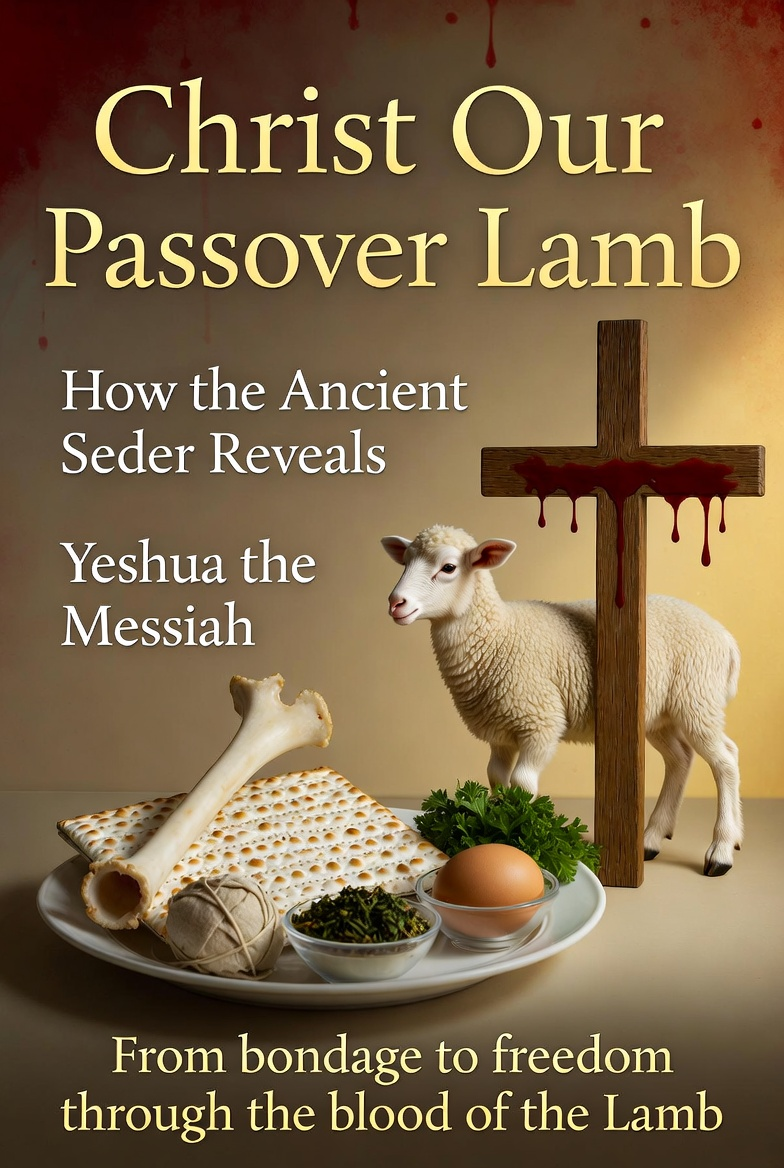
At the center of the Seder plate stands the z'roah, the roasted shank bone of a lamb. In Jewish tradition, it recalls the Passover lamb sacrificed in Egypt, its blood applied to the doorposts and lintels so that the destroyer would pass over Israelite homes. The instructions in Exodus 12:1-13 are precise and profound. God commanded Moses and Aaron: "This month is to be for you the first month, the first month of your year. Tell the whole community of Israel that on the tenth day of this month each man is to take a lamb for his family, one for each household... The animals you choose must be year-old males without defect, and you may take them from the sheep or the goats... Then they are to take some of the blood and put it on the sides and tops of the doorframes of the houses where they eat the lambs... The blood will be a sign for you on the houses where you are, and when I see the blood, I will pass over you" (Exodus 12:2-7, 13, NIV). Further details emphasize the lamb's integrity: "It must be eaten inside the house; take none of the meat outside the house. Do not break any of the bones" (Exodus 12:46), a command echoed in Numbers 9:12.
This was no ordinary meal. The lamb was selected on the tenth day, observed for blemishes until the fourteenth, then slaughtered at twilight. Its blood—applied with hyssop—acted as a protective seal. Families roasted the lamb whole, eating it with unleavened bread and bitter herbs in haste, ready for departure. The stakes were eternal: obey and live; neglect the blood and face the plague that claimed Egypt's firstborn.
In the New Testament, this typology finds its stunning climax in Jesus. John the Baptist proclaimed, "Look, the Lamb of God, who takes away the sin of the world!" (John 1:29, NIV). Here is the spotless Lamb, without defect, whose blood does not merely avert temporal judgment but eradicates sin's penalty forever. Paul makes the connection explicit: "For Christ, our Passover lamb, has been sacrificed" (1 Corinthians 5:7, NIV). The crucifixion details fulfill the type with breathtaking precision. As Jesus hung on the cross, the soldiers came to break the legs of the condemned to hasten death before the Sabbath. "But when they came to Jesus and found that he was already dead, they did not break his legs... These things happened so that the scripture would be fulfilled: 'Not one of his bones will be broken'" (John 19:33-36, NIV). The unbroken bones echo Exodus 12:46 and Numbers 9:12 exactly.
Consider the weight of this fulfillment. In Egypt, one lamb per household spared a family. At Calvary, the singular Lamb of God—Jesus—offered Himself once for all (Hebrews 10:10). His blood, applied by faith to our hearts, causes God's righteous judgment to pass over us. No longer slaves to sin, we are set free (Romans 6:6-7). Early Messianic believers saw this vividly: the Passover lamb's blood on wooden doorposts prefigures the blood on the wooden cross. The destroyer passed over because of the lamb; death passes over us because of the Lamb. This is not coincidence but divine design, revealing Christ's redemptive work embedded in the very fabric of Israel's foundational feast.
For believers today, the shank bone on the Seder plate is a silent preacher. It whispers of substitutionary atonement: the innocent dying for the guilty. It calls us to examine our lives—have we applied the blood? In a world still groaning under sin's bondage, Christ alone is our Passover. As Revelation 5:12 thunders in heavenly worship, "Worthy is the Lamb, who was slain, to receive power and wealth and wisdom and strength and honor and glory and praise!" The z'roah points us to the cross, where redemption was purchased not with silver or gold, but with precious blood (1 Peter 1:18-19).
Unleavened Bread (Matzah): The Pierced, Striped Bread of Affliction and the Afikoman's Hidden Hope
Central to the Seder is the matzah—unleavened bread, often called the "bread of affliction." Three pieces of matzah are placed in a special holder, their flat, striped, and pierced appearance evoking haste and suffering. Exodus 12:8 commands, "That same night they are to eat the meat roasted over the fire, along with bitter herbs, and bread made without yeast." Exodus 12:15-20 reinforces the removal of all leaven: "For seven days you are to eat bread made without yeast... whoever eats anything with yeast in it... must be cut off from Israel." Deuteronomy 16:3 calls it "the bread of affliction," reminding Israel of their hurried exit from Egypt, with no time for dough to rise.
In the Seder, the middle matzah is broken in half. One half—the afikoman—is wrapped in linen, hidden away, later "found" by children, redeemed with a price, and eaten as the final taste of the meal. This ritual, layered over centuries, carries profound Messianic depth. Leaven in Scripture symbolizes sin and corruption (1 Corinthians 5:6-8). Removing it pictures purity. The matzah's stripes and piercings mirror Isaiah 53:5: "But he was pierced for our transgressions, he was crushed for our iniquities; the punishment that brought us peace was on him, and by his wounds we are healed."
At the Last Supper—a Passover meal—Jesus took this bread: "And he took bread, gave thanks and broke it, and gave it to them, saying, 'This is my body given for you; do this in remembrance of me'" (Luke 22:19, NIV; see also 1 Corinthians 11:23-24). Paul connects it directly: "Cleanse out the old leaven... For Christ, our Passover lamb, has been sacrificed. Let us therefore celebrate the festival, not with the old leaven, the leaven of malice and evil, but with the unleavened bread of sincerity and truth" (1 Corinthians 5:7-8). Jesus declares Himself "the bread of life" (John 6:35, 48), the sustenance that satisfies eternally.
The three matzot symbolize profound unity—often interpreted as the triune nature of God: Father, Son, and Holy Spirit, one in essence (echad). The middle piece, representing the Son, is broken, wrapped, hidden (burial), and later revealed (resurrection). The afikoman's "ransom" echoes Mark 10:45: "For even the Son of Man did not come to be served, but to serve, and to give his life as a ransom for many." Jesus' body, broken on the cross, wrapped in linen, placed in a tomb, and raised on the third day, fulfills this drama perfectly. The hidden afikoman, redeemed and shared, mirrors how believers "find" the resurrected Christ and receive His life.
This element challenges us deeply. Leaven must be purged—not just from homes, but from hearts. Christ's sinless body, pierced and striped, offers healing and wholeness. In the Seder, eating the afikoman as the meal's climax reminds us that communion with Christ is the true feast. No longer afflicted by sin's yeast, we feast on sincerity and truth. For the church, this transforms the Lord's Supper from ritual to intimate remembrance: His body broken for us, His blood sealing the new covenant. The matzah calls every believer to live unleavened lives—holy, set apart—because the Bread of Life has come.
Expanding on this, the haste of the Exodus mirrors the urgency of salvation. Just as Israel ate standing, sandals on, staff in hand, so we must respond swiftly to the gospel. The pierced matzah prefigures the spear in Jesus' side (John 19:34), releasing blood and water—symbols of cleansing and life. In Messianic celebrations, breaking the middle matzah visibly enacts the cross, inviting participants to see Christ's suffering not as distant history but as personal provision. The afikoman hunt, joyful and childlike, pictures the resurrection's triumph: what was hidden is now revealed, what was lost is redeemed. This is no mere custom; it is prophetic theater, scripted by the Holy Spirit across millennia, culminating in the empty tomb.
Bitter Herbs (Maror): The Sting of Slavery and the Bitterness of Sin Redeemed
The maror—typically horseradish or romaine lettuce—brings tears to the eyes, symbolizing the bitterness of Egyptian slavery. Exodus 12:8 instructs Israel to eat the lamb "with bitter herbs." This sharp reminder of oppression contrasts the sweetness of deliverance, grounding the Seder in raw reality. The labor was grueling: brickmaking under ruthless taskmasters, cries ascending to heaven (Exodus 2:23).
In the Christian lens, maror points to the bitterness of sin's bondage and the suffering Jesus endured to free us. Dipping herbs recalls the meal's intimacy, possibly echoed when Jesus dipped bread for Judas (John 13:26). The overall theme of deliverance ties to John 8:36: "So if the Son sets you free, you will be free indeed." Sin's bitterness—guilt, shame, separation from God—is swallowed up in Christ's victory. His agony in Gethsemane and on the cross absorbed the full weight of humanity's affliction. The herbs, eaten after the matzah in some traditions, remind us that suffering precedes glory. Jesus, the Man of Sorrows (Isaiah 53:3), tasted bitterness so we might savor freedom.
This element fosters empathy and gratitude. Just as Israel remembered slavery to value liberty, believers recall sin's chains to cherish the cross. Maror is not an end but a passage: bitterness gives way to redemption. In personal application, it urges honest confession—facing sin's sting before feasting on grace.
Charoset: The Sweet Mortar of Labor and the Hope Blended in Suffering
Charoset, a sweet mixture of apples, nuts, cinnamon, and wine, represents the mortar and bricks of Israel's forced labor (Exodus 1:13-14). Its texture evokes hardship, yet its sweetness hints at redemption's promise amid trial. Though lacking a single direct New Testament verse, it fits the broader narrative of suffering yielding to salvation, as seen in the Last Supper accounts and 1 Corinthians 5.
In Christ, charoset illustrates how God weaves sweetness into sorrow. Jesus' suffering—bitter labor on the cross—produced the sweet fruit of salvation. The mixture mirrors life's blend: trials tempered by hope (Romans 5:3-5). For believers, it whispers that even in bondage, God's purposes are sweet. The redemption story turns mortar into milestone, pointing to the new creation where tears are wiped away.
This teaches resilience. Charoset on the Seder plate invites reflection: our "bricks" of pain, dipped with maror, become testimonies of grace. Christ's resurrection sweetens every bitterness.
The Roasted Egg (Beitzah): Symbol of New Life and the Empty Tomb's Promise
The beitzah, a roasted egg, represents the festival offering or new life, also evoking mourning for the Temple. Tied to sacrifices in Numbers 28, it speaks of renewal. In the Messianic view, it foreshadows Jesus' resurrection and the new life believers receive. The empty tomb (Gospels) echoes an egg's potential—life emerging from apparent death. Eternal life through Christ transforms mourning into joy. The egg reminds us: death could not hold the Passover Lamb. We are raised with Him (Ephesians 2:6), new creations in the resurrected One.
Karpas: The Green Herb of Renewal Dipped in Tears, and Hyssop at the Cross
Karpas—parsley or a vegetable—dipped in salt water symbolizes spring's renewal and the tears of slavery (Exodus 2:23). It also recalls hyssop, used to apply blood (Exodus 12:22). At the cross, hyssop offered sour wine to Jesus (John 19:29). Salt water as tears is redeemed by Christ's sacrifice. This ties to cleansing themes (Titus 3:5), washing in His blood. Karpas pictures hope emerging from sorrow, hyssop bridging Exodus to Calvary. Dipping invites participation in redemption's story: tears become testimony.
The Four Cups of Wine: God's "I Will" Promises Sealed in the New Covenant
The four cups correspond to Exodus 6:6-7: sanctification ("I will bring you out"), deliverance ("I will free you"), redemption ("I will redeem you with an outstretched arm"), and acceptance ("I will take you as my people"). Wine symbolizes joy. Jesus took cups at the Last Supper: "This cup is the new covenant in my blood, which is poured out for you" (Luke 22:20, NIV; 1 Corinthians 11:25). The third cup (redemption) links to the New Covenant (Jeremiah 31:31). Some see the fourth completed on the cross with sour wine (John 19:28-30). These promises find fulfillment in Christ: brought out of sin's Egypt, freed, redeemed by His arm on the cross, accepted as God's people. The cups invite drinking deeply of grace, celebrating the new covenant meal.
The Maggid: Retelling the Exodus as the Gospel Story
The Maggid section retells Exodus 12-15, from slavery to song. Jesus' Last Supper reframed this as His own exodus (Luke 9:31). Paul urges celebrating "with the unleavened bread of sincerity and truth" (1 Corinthians 5:8). The full narrative—plagues, Red Sea, wilderness—mirrors the sinner's journey: bondage, blood, baptism-like crossing, provision. In Christ, the story is ours: from darkness to light.
The Last Supper: Passover Perfected in the Upper Room
Matthew 26, Mark 14, and Luke 22 record Jesus transforming the Seder. As the Lamb, He instituted remembrance. The bread and cup became His body and blood. This seamless transition from old to new reveals continuity: one redemption plan.
Conclusion: Embracing the Passover Lamb Today
Every Seder element converges on Calvary and the empty tomb. Christ is our Lamb, Bread, Redeemer. Traditional observance honors history; the Messianic lens beholds the Messiah. As we apply His blood by faith, we pass from death to life. Celebrate with sincerity, live in freedom, proclaim the Lamb worthy. Next year—and every year—in the presence of the risen Christ.


Comments