Understanding Maundy Thursday: The Commandment of Love and Service
- David Campbell Jr.

- Apr 2
- 9 min read
Understanding Maundy Thursday: The Commandment of Love and Service
Maundy Thursday, also known as Holy Thursday or the Thursday of the Lord’s Supper, stands as one of the most profound observances in the Christian calendar. It falls on the Thursday before Easter Sunday and marks the beginning of the Paschal Triduum—the sacred three days that encompass Jesus Christ’s passion, death, and resurrection. This day commemorates the events of the Upper Room, where Jesus shared His final meal with the disciples, instituted the Lord’s Supper, washed their feet in an act of profound humility, and issued a new commandment to love one another as He had loved them.
The name “Maundy” derives from the Latin word mandatum, meaning “commandment” or “mandate.” It directly references Jesus’ words in the Gospel of John: “A new command I give you: Love one another. As I have loved you, so you must love one another” (John 13:34, NIV). Far from a mere historical recollection, Maundy Thursday invites believers to reflect on the depth of Christ’s sacrificial love, the call to humble service, and the establishment of the new covenant through His body and blood. In a world often marked by division and self-interest, this day challenges Christians to embody the very love and servanthood that Jesus modeled on the eve of His betrayal and crucifixion.
Maundy Thursday occurs within Holy Week, following Palm Sunday and the events of Spy Wednesday (when Judas agreed to betray Jesus). It precedes Good Friday, the day of the crucifixion, and Holy Saturday, the day of waiting and anticipation. Together, these form the Triduum, a unified liturgical journey that culminates in the joy of Easter. Early Christian writings, including references in the works of Justin Martyr around AD 150, indicate that the church has observed these events since the earliest centuries, though the specific name and customs evolved over time.
At its core, Maundy Thursday is not about ritual alone but about transformation. It reminds us that true discipleship flows from receiving Christ’s love and extending it outward. As we explore the biblical foundations, historical practices, and enduring significance of this day, we see how it calls every generation to live out the mandate of love through humble service.
The Biblical Foundation: The Last Supper and the New Covenant
The events of Maundy Thursday unfold primarily in the Upper Room in Jerusalem during the Passover festival. The Synoptic Gospels—Matthew, Mark, and Luke—describe the meal as a Passover celebration, while the Gospel of John emphasizes the foot-washing and the new commandment. These accounts together paint a vivid picture of Jesus’ final hours with His closest followers before His arrest.
According to Luke’s Gospel, Jesus deliberately prepared for this meal, sending Peter and John to make arrangements:
“Then came the day of Unleavened Bread on which the Passover lamb had to be sacrificed. Jesus sent Peter and John, saying, ‘Go and make preparations for us to eat the Passover.’ ‘Where do you want us to prepare for it?’ they asked. He replied, ‘As you enter the city, a man carrying a jar of water will meet you. Follow him to the house that he enters, and say to the owner of the house, “The Teacher asks: Where is the guest room, where I may eat the Passover with my disciples?”’ He will show you a large room upstairs, all furnished. Make preparations there.” They left and found things just as Jesus had told them. So they prepared the Passover. When the hour came, Jesus and his apostles reclined at the table. And he said to them, ‘I have eagerly desired to eat this Passover with you before I suffer. For I tell you, I will not eat it again until it finds fulfillment in the kingdom of God.’ After taking the cup, he gave thanks and said, ‘Take this and divide it among you. For I tell you I will not drink again from the fruit of the vine until the kingdom of God comes.’ And he took bread, gave thanks and broke it, and gave it to them, saying, ‘This is my body given for you; do this in remembrance of me.’ In the same way, after the supper he took the cup, saying, ‘This cup is the new covenant in my blood, which is poured out for you.’” (Luke 22:7-20, NIV)
This passage reveals several layers of meaning. First, the Passover context is crucial. For centuries, Jewish families had celebrated Passover to remember God’s deliverance from Egypt through the blood of the lamb. Jesus, as the true Passover Lamb (1 Corinthians 5:7), now reinterprets the meal. The bread and cup become symbols of His impending sacrifice—His body broken and His blood poured out for the forgiveness of sins. By declaring, “This is my body given for you” and “This cup is the new covenant in my blood,” Jesus establishes the Lord’s Supper, or Eucharist, as the central act of Christian worship. It is a perpetual memorial, not merely of a past event, but of an ongoing reality: Christ’s presence with His people until He returns.
The Apostle Paul later reinforces this in his letter to the Corinthians, writing:
“For I received from the Lord what I also passed on to you: The Lord Jesus, on the night he was betrayed, took bread, and when he had given thanks, he broke it and said, ‘This is my body, which is for you; do this in remembrance of me.’ In the same way, after supper he took the cup, saying, ‘This cup is the new covenant in my blood; do this, whenever you drink it, in remembrance of me.’ For whenever you eat this bread and drink this cup, you proclaim the Lord’s death until he comes.” (1 Corinthians 11:23-26, NIV)
Paul’s account, received directly from the Lord, underscores that the Lord’s Supper is both remembrance and proclamation. It unites believers across time and space, declaring the gospel through simple elements. On Maundy Thursday, many churches celebrate Communion with heightened solemnity, often stripping the altar afterward to symbolize Christ’s abandonment and prepare for Good Friday’s starkness.
The meal also carried tension. Jesus predicted His betrayal, and the disciples argued about greatness (Luke 22:24). Into this human frailty, Jesus introduced the profound act of foot-washing, shifting the focus from status to service.
The Humble Act of Foot-Washing: An Example for All
The Gospel of John provides the most detailed account of the foot-washing, an event unique to this Gospel yet central to Maundy Thursday’s identity. John sets the scene with theological depth:
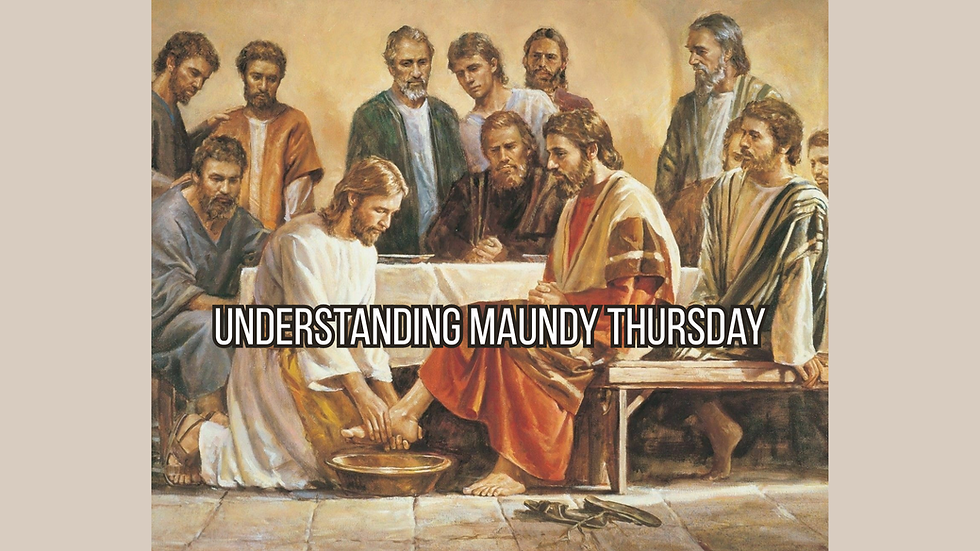
“It was just before the Passover Festival. Jesus knew that the hour had come for him to leave this world and go to the Father. Having loved his own who were in the world, he loved them to the end. The evening meal was in progress, and the devil had already prompted Judas, the son of Simon Iscariot, to betray Jesus. Jesus knew that the Father had put all things under his power, and that he had come from God and was returning to God; so he got up from the meal, took off his outer clothing, and wrapped a towel around his waist. After that, he poured water into a basin and began to wash his disciples’ feet, drying them with the towel that was wrapped around him.” (John 13:1-5, NIV)
In first-century Palestine, foot-washing was the task of the lowliest servant. Guests reclined at low tables, and dusty roads left feet filthy. Yet Jesus, fully aware of His divine authority, performed this menial service. The act was not symbolic only; it was incarnational love in action.
Peter’s reaction captures the disciples’ shock:
“He came to Simon Peter, who said to him, ‘Lord, are you going to wash my feet?’ Jesus replied, ‘You do not realize now what I am doing, but later you will understand.’ ‘No,’ said Peter, ‘you shall never wash my feet.’ Jesus answered, ‘Unless I wash you, you have no part with me.’ ‘Then, Lord,’ Simon Peter replied, ‘not just my feet but my hands and my head as well!’ Jesus answered, ‘Those who have had a bath need only to wash their feet; their whole body is clean. And you are clean, though not every one of you.’ For he knew who was going to betray him, and that was why he said not every one was clean.” (John 13:6-11, NIV)
Jesus’ response to Peter reveals layers of spiritual truth. The “bath” refers to the cleansing of salvation, while foot-washing symbolizes ongoing cleansing from daily sin through confession and reliance on Christ. Judas, though present, remained unclean in heart because of his betrayal.
After completing the task, Jesus explained its purpose:
“When he had finished washing their feet, he put on his clothes and returned to his place. ‘Do you understand what I have done for you?’ he asked them. ‘You call me “Teacher” and “Lord,” and rightly so, for that is what I am. Now that I, your Lord and Teacher, have washed your feet, you also should wash one another’s feet. I have set you an example that you should do as I have done for you. Very truly I tell you, no servant is greater than his master, nor is a messenger greater than the one who sent him. Now that you know these things, you will be blessed if you do them.’” (John 13:12-17, NIV)
This teaching inverts worldly values. Greatness in the kingdom comes through servanthood. Jesus, the Lord and Teacher, became the servant, foreshadowing the cross where He would serve humanity by dying in its place (Philippians 2:5-8). The blessing promised—“you will be blessed if you do them”—is not automatic; it flows from obedient imitation of Christ.
The New Commandment: Love as the Mark of Discipleship
Following the foot-washing, Jesus delivered the mandate that gives the day its name:
“A new command I give you: Love one another. As I have loved you, so you must love one another. By this everyone will know that you are my disciples, if you love one another.” (John 13:34-35, NIV)
The commandment was not entirely new—Leviticus 19:18 had called for neighborly love—but Jesus elevated it. The standard is now “as I have loved you”—a sacrificial, unconditional, servant-hearted love demonstrated supremely on the cross. This love becomes the identifying mark of the church. In a divided world, authentic Christian community testifies to the gospel more powerfully than words alone.
Jesus expanded on this love in the Upper Room Discourse (John 14–17), promising the Holy Spirit as Helper and praying for the unity of believers. The new commandment, therefore, is not a burdensome rule but an invitation into the very life of the Trinity—mutual love and self-giving.
Historical Development and Liturgical Traditions
The observance of Maundy Thursday traces back to the early church. By the fourth century, it was firmly established in both Eastern and Western traditions. The term “Maundy” entered English through Old French from the Latin mandatum. In medieval Europe, monarchs like Edward I of England began the custom of distributing alms and washing feet, a practice that evolved into the British Royal Maundy ceremony, where the sovereign distributes specially minted coins to the elderly.
In the Roman Catholic tradition, Maundy Thursday features two key liturgies. The morning Chrism Mass sees bishops blessing holy oils for baptism, confirmation, and anointing of the sick. In the evening, the Mass of the Lord’s Supper includes the possibility of foot-washing (Mandatum), where the priest washes the feet of twelve people, symbolizing the apostles. The Blessed Sacrament is then carried in procession to an Altar of Repose, and the main altar is stripped bare, evoking Christ’s desolation. Church bells fall silent until Easter.
Eastern Orthodox churches call it Great and Holy Thursday. The Divine Liturgy of St. Basil includes a composite Gospel reading and foot-washing in cathedrals. The fast is slightly relaxed, and dark vestments signal the shift into Passiontide. Oriental Orthodox traditions, such as the Coptic and Syriac, emphasize the “Thursday of Mysteries” with readings on the betrayal and the first liturgy.
Protestant denominations vary. Anglicans, Lutherans, Methodists, and Presbyterians often hold services combining Communion and foot-washing, sometimes stripping the altar to Psalms of lament. Some Reformed and evangelical churches focus primarily on the Lord’s Supper without foot-washing, viewing the latter as optional. Across traditions, the emphasis remains on humility, reconciliation, and the command to love.
Theological Significance and Contemporary Application
Theologically, Maundy Thursday encapsulates the heart of the gospel. The foot-washing prefigures the cross: Jesus stoops low to cleanse what is unclean. The Lord’s Supper proclaims the new covenant, replacing the old system of animal sacrifice with the once-for-all offering of Christ. The new commandment fulfills the law by rooting obedience in relationship rather than rule-keeping.
In practical terms, Maundy Thursday confronts modern individualism. It asks: Are we willing to wash one another’s feet—metaphorically serving in unglamorous ways? In families, churches, workplaces, and communities, this means forgiving offenses, bearing burdens, and prioritizing others’ needs. Pastors and leaders especially must model this, lest they become like the arguing disciples rather than like their Master.
For those facing suffering, Maundy Thursday offers hope. Jesus knew betrayal, abandonment, and death were coming, yet He loved “to the end” (John 13:1). Believers can trust the same sustaining love amid trials.
Conclusion: Living the Mandate
Maundy Thursday is more than a date on the calendar; it is a summons to embody the love that conquered death. As we gather for Communion, wash feet, or simply reflect in quiet, may we hear Jesus’ voice anew: “Now that you know these things, you will be blessed if you do them” (John 13:17). In a fractured world, let the church be known by this love. Let us go forth from Maundy Thursday not merely informed but transformed—servants who love as Christ loved, until He comes again.


Comments